 Curveswap
 fees depend on the pool and the transactions your first swap requires
Updated -
Curveswap fees include the trading charge reflected in the swap quote and separate network charges for required transactions. Your first swap may also need a token approval that consumes gas. Compare the output available for the same input amount, then account for approval and execution costs without subtracting pool fees twice. Pool configuration, liquidity, and route selection affect that comparison. A low displayed trading fee alone does not establish the cheapest usable exchange.
Costs appear in the quote and the wallet request
The amount quoted for the swap
Curve quotes account for the pool trading fee when calculating expected output. A route through several pools incorporates the exchanges along that path. Curve's own swap frontend does not add a frontend fee, although another interface may apply its own charge. The identity of the interface therefore matters when interpreting a fee breakdown. A quote that includes pool fees still needs a separate assessment of network costs.
Approval and execution charges
A token approval and a swap are separate operations when the selected spending contract lacks sufficient allowance. Each submitted transaction can incur a network charge. An existing allowance may remove the need for another approval, but it belongs to a specific owner, token, and spender. Changing the spending contract can change the preparation cost. The wallet request identifies which operation you are paying to execute.
Does a lower pool fee mean a cheaper swap?
A lower pool fee does not necessarily produce a cheaper swap because available liquidity, execution prices, and network costs also affect the outcome.
Compare quotes for the same input token, input quantity, output token, and network at roughly the same time. Otherwise, a difference in the requested trade can look like a fee saving. The amount available after trading fees is the useful starting point. Subtract only costs that the quote excludes, after expressing them in a common unit. That comparison measures economic value; it does not change which asset actually pays each charge.
A payment or deposit may require a particular output quantity. An economically attractive route can still fail that requirement if its minimum received is too low. Keep that quantity constraint separate from the comparison of costs.
Pool configuration determines the applicable trading charge
Fixed pool fees
Some Curve pool implementations use a configured swap fee that remains fixed until an authorized parameter change takes effect. That setting belongs to the individual pool. It does not establish a universal Curveswap rate, and a fee remembered from an earlier trade may describe a different pool or configuration.
StableSwap-NG dynamic fees
StableSwap-NG combines a base fee with an off-peg fee multiplier. When the multiplier enables dynamic charging, the balance relationship used by the calculation can increase the effective fee. The base parameter alone therefore does not describe every trade. The swap calculation also uses the trade's effect on those balances, so a quote for a different amount may carry a different effective charge.
CryptoSwap fee ranges
CryptoSwap designs use fee parameters for balanced and imbalanced pool states, with a transition governed by the pool's configuration. A single advertised percentage can hide that variation. Compare executable quotes for your amount instead of treating either endpoint as the fee for every exchange. Liquidity matters here because the pool's balance affects both pricing and the applicable dynamic charge.
Who receives the fee that the pool charges?
Pool trading fees support liquidity providers, while an applicable admin share goes into the protocol's fee collection and distribution arrangements.
The admin fee is a share of the pool trading fee rather than an additional charge on the full swap amount. Adding both percentages as separate trading charges would overstate the cost. The allocation depends on the relevant implementation and settings. Curve's distribution system includes payments to veCRV holders, who hold vote-escrowed governance balances; the trader does not make a separate payment to each recipient.
The network budget sits outside the token quote
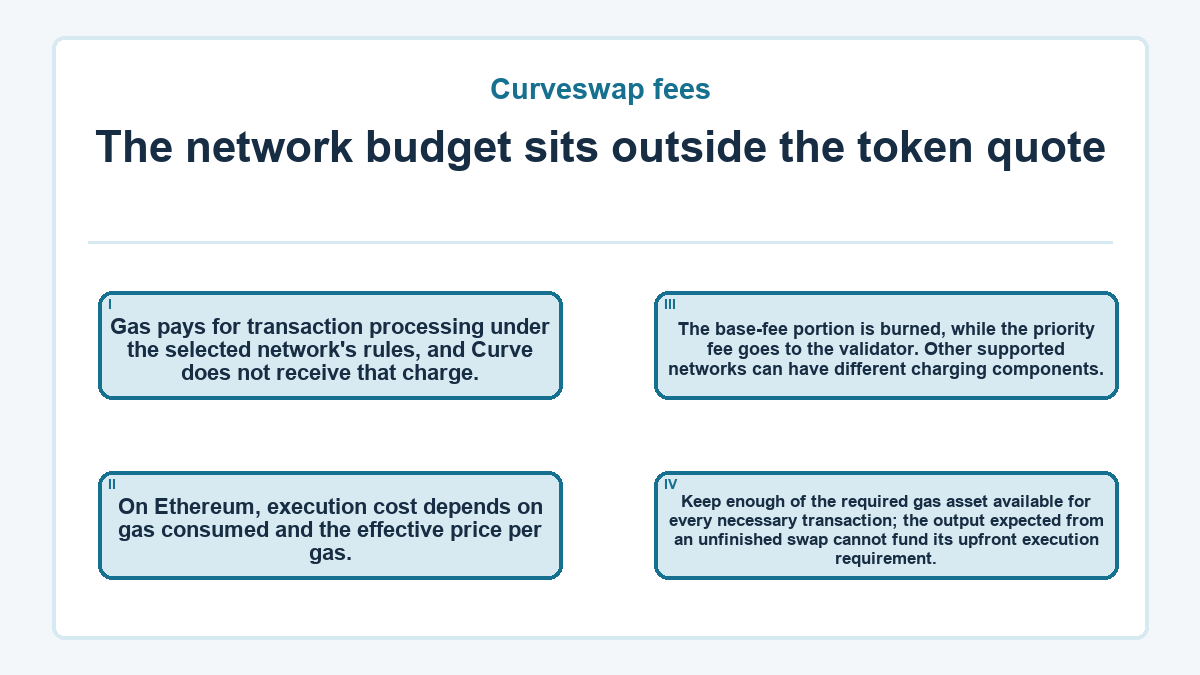
Gas pays for transaction processing under the selected network's rules, and Curve does not receive that charge. On Ethereum, execution cost depends on gas consumed and the effective price per gas. The base-fee portion is burned, while the priority fee goes to the validator. Other supported networks can have different charging components. Keep enough of the required gas asset available for every necessary transaction; the output expected from an unfinished swap cannot fund its upfront execution requirement.
Price impact and slippage affect value differently
Price impact describes how the trade changes its execution price through the pool's pricing mechanism. Slippage describes a difference between the quoted and executed outcome. Neither is automatically another fee paid to Curve. The minimum-output condition limits acceptable execution, and a swap that cannot satisfy it reverts. Raising tolerance permits a worse outcome; it does not reduce the trading charge. These distinctions help explain a disappointing quote without treating every difference as a hidden fee.
Available swap choices and their cost boundaries
A direct pool exchange, a routed exchange, and an aggregator can expose different costs for the same intended conversion. Availability depends on the tokens and supported contracts. An aggregator can include Curve liquidity while applying separate interface or execution terms. Where a route includes a liquidity deposit, withdrawal, or wrapping operation, its complete quote and gas estimate matter. Counting only explicit exchange steps can miss work that the route performs.
| Available choice | Cost inputs to compare | Limit or stopping point |
|---|---|---|
| Direct pool swap | Pool quote, allowance needs, and transaction gas | Requires a pool that supports the requested exchange |
| Curve routed swap | Final route output and gas for its operations | Requires a supported route and acceptable minimum output |
| Aggregator using Curve liquidity | Net quote, disclosed service charges, and execution costs | Provider-specific authorization and execution conditions apply |
| Defer the exchange | No new transaction charge while nothing is submitted | Current quotes and pool conditions are not reserved |
| Compare the same requested conversion, including every charge that its final output quote excludes. | ||
Direct execution can reduce contract work, while routing can improve the exchange price. Neither advantage establishes the winner before both costs are considered.
An extra approval can change the cheaper choice
Consider a hypothetical first swap with direct and routed quotes for the same input amount and output token. The direct quote returns 248.68 output tokens, and the routed quote returns 249.08. Both include trading fees. Their estimated network costs, converted into output-token equivalents, are 0.38 and 1.18 respectively. Initially, the comparison assumes sufficient allowance for both spending contracts.
The direct option has an estimated net value of 248.68 - 0.38 = 248.30 output tokens. The routed option has an estimated net value of 249.08 - 1.18 = 247.90. Direct execution leads by 0.40 output tokens in economic value. Gas still comes from the required gas asset; these subtractions do not describe deductions from the received tokens.
The allowance check then shows insufficient permission for the direct pool, contrary to the initial assumption. That option now requires an approval transaction. If its additional cost exceeds 0.40 output-token equivalents, the routed option becomes cheaper under otherwise unchanged assumptions. At exactly 0.40, their estimated net values match. A refreshed quote or gas estimate can change this boundary again.
Check that the revised total is acceptable, you have enough funds for gas, and the minimum output meets your needs. If an approval has been submitted, wait for confirmation and verify that the allowance covers the swap before proceeding. If the revised trade no longer fits, stop before submitting the swap. Any gas already spent on approval remains a cost of preparation.
Confirm that the swap receipt shows success and that the intended recipient received the output tokens. Record actual transaction costs alongside the received amount, replacing estimates with the amounts charged. An approval receipt alone does not establish an exchange, and a pending swap does not establish its final cost.
The unsigned swap remains a stopping point
Before swap submission, abandoning an unacceptable quote avoids that swap's network charge. A previously completed approval remains separate, including its cost and any surviving allowance. Once a transaction executes and reverts, gas consumed by the attempt remains payable even though its trade changes roll back. Repeated unchanged attempts can therefore increase expenditure without obtaining the required token.
The next decision is whether the refreshed quote still provides the required output at an acceptable total cost. Keep the input amount, minimum received, and remaining gas balance in view. A cheaper route is useful only when its supported execution also completes the conversion that you need.
Still wondering about Curveswap fees?
Will splitting my first swap into smaller trades reduce the total cost?
Splitting a swap can increase total network costs because separately submitted trades each require execution. Smaller trades also interact with changing pool balances, so their combined output need not beat one larger exchange. Compare the total output and all transaction charges across the proposed split before treating it as a saving.
Is the wallet's maximum gas estimate always the amount charged?
A maximum gas estimate is not necessarily the final charge. On Ethereum, actual execution cost uses the gas consumed and effective gas price, subject to the transaction's fee settings. A higher maximum is a spending bound rather than proof that the entire amount will be used.
Does approving a larger token amount create a larger pool trading fee?
The approved allowance does not determine the pool trading fee; the executed swap does. A larger allowance changes how much the specified spender may subsequently transfer. It does not exchange that amount immediately or establish a discounted fee. Approval gas and the permission that remains afterward are separate considerations.
Do I pay gas to revoke an approval after abandoning a swap?
Changing an allowance through an on-chain approval transaction requires gas, including when the new allowance is zero. That cost belongs to permission management rather than the pool's swap fee. Revoking an allowance does not refund an earlier approval charge or reverse a completed exchange.
How should I compare a quote that has no gas estimate?
A quote without a gas estimate provides an incomplete cost comparison. Missing information does not mean execution is free. Keep its quoted token output separate from the unresolved network cost, including any approval transaction. A small output advantage cannot establish the cheaper option while those costs remain unknown.
Would swapping back recover the original amount and fees?
Swapping back is another trade with its own quote and applicable charges. Pool balances, execution prices, and network costs may differ by then. The reverse exchange does not refund the first transaction's fees, so its expected output must be assessed separately from the amount originally supplied.
What happens to my costs if I cancel in the wallet before submitting the swap?
Rejecting an unsigned swap request does not incur that swap's on-chain execution charge because no swap transaction is submitted. This does not refund any approval that already executed. It also differs from attempting to replace a transaction that has already been broadcast, where transaction-processing rules and costs apply.